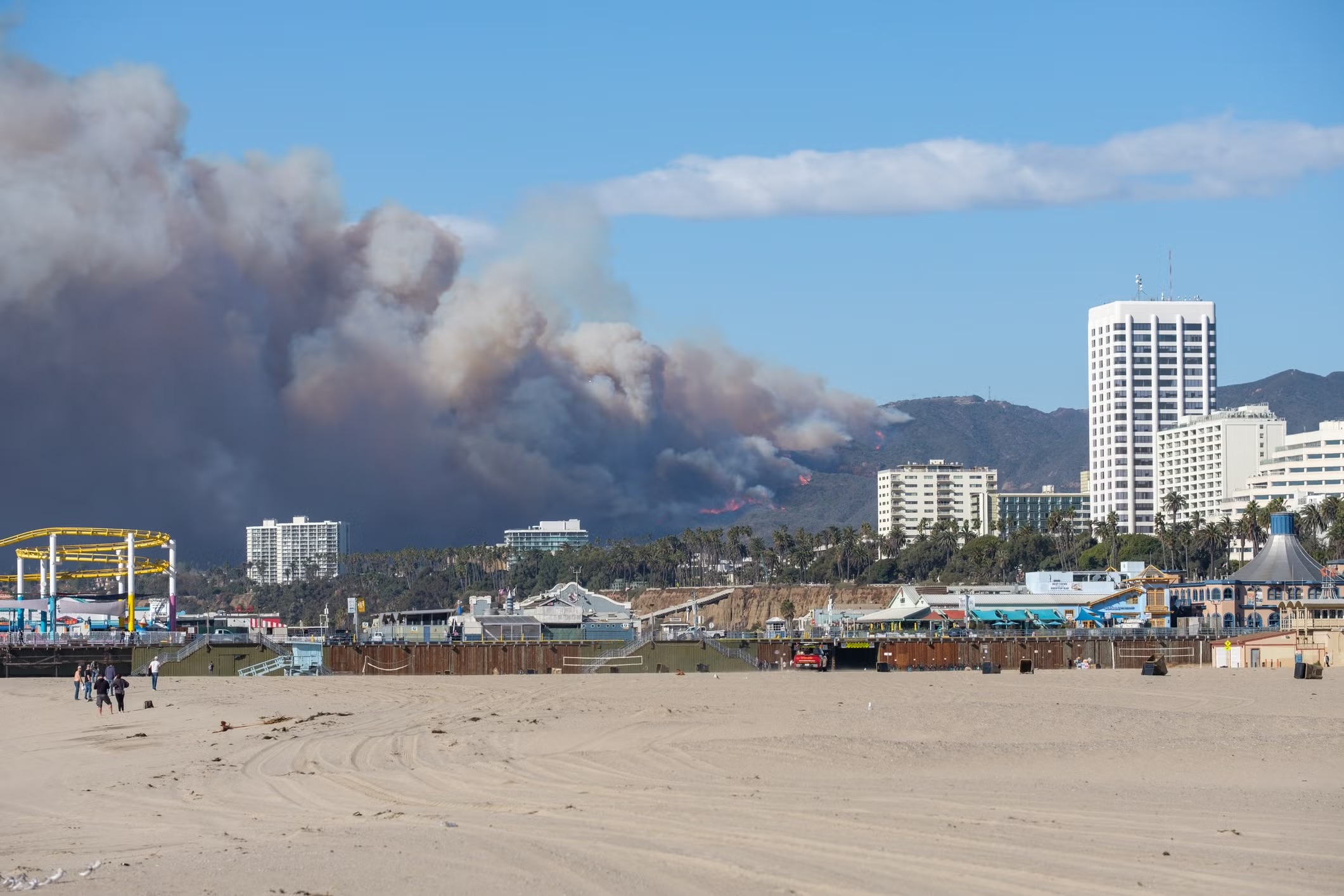
Pictured above: The Palisades Fire of January 2025 burned watersheds in the Santa Monica Mountains, subsequently affecting water quality at several Southern California beaches. Photo by Ward DeWitt via iStock.
Twenty years of data across 204 coastal watersheds reveal distinct post-fire bacterial patterns, with urban watersheds showing more fecal coliforms after fires.
UC Santa Barbara researchers have identified links between wildfires in California’s coastal watersheds and changes in bacterial water quality at beaches where those watersheds meet the ocean.
Jean Carlson, a professor in UC Santa Barbara’s Department of Physics, and Carl Swindle, a UCSB Earth Science alumnus and postdoctoral researcher at UCLA and Caltech, analyzed 20 years of wildfire and beach water-quality data across 204 ocean-bound watersheds in California.
The researchers compared wildfire histories with precipitation, land cover and four types of fecal indicator bacteria. Their analysis revealed different post-fire responses depending on the characteristics of each watershed.
“In the urban areas, we see a rise of fecal bacteria associated with wildfires, while total coliforms actually go down,” Carlson said.
Urban-dominated watersheds were associated with more fecal coliforms in coastal waters after fires, while less urbanized watersheds with more vegetation showed more diverse and typically less harmful coliform bacteria. The researchers found the most post-fire fecal indicator bacteria anomalies in the Goleta Watershed in Santa Barbara County.
The findings, published in PLOS Water, could give coastal communities better tools to plan for beach closures, freshwater purification and debris management after fires and major storms.
The researchers plan to expand the approach to additional pollutants and water-quality conditions associated with wildfires, including harmful algal blooms.