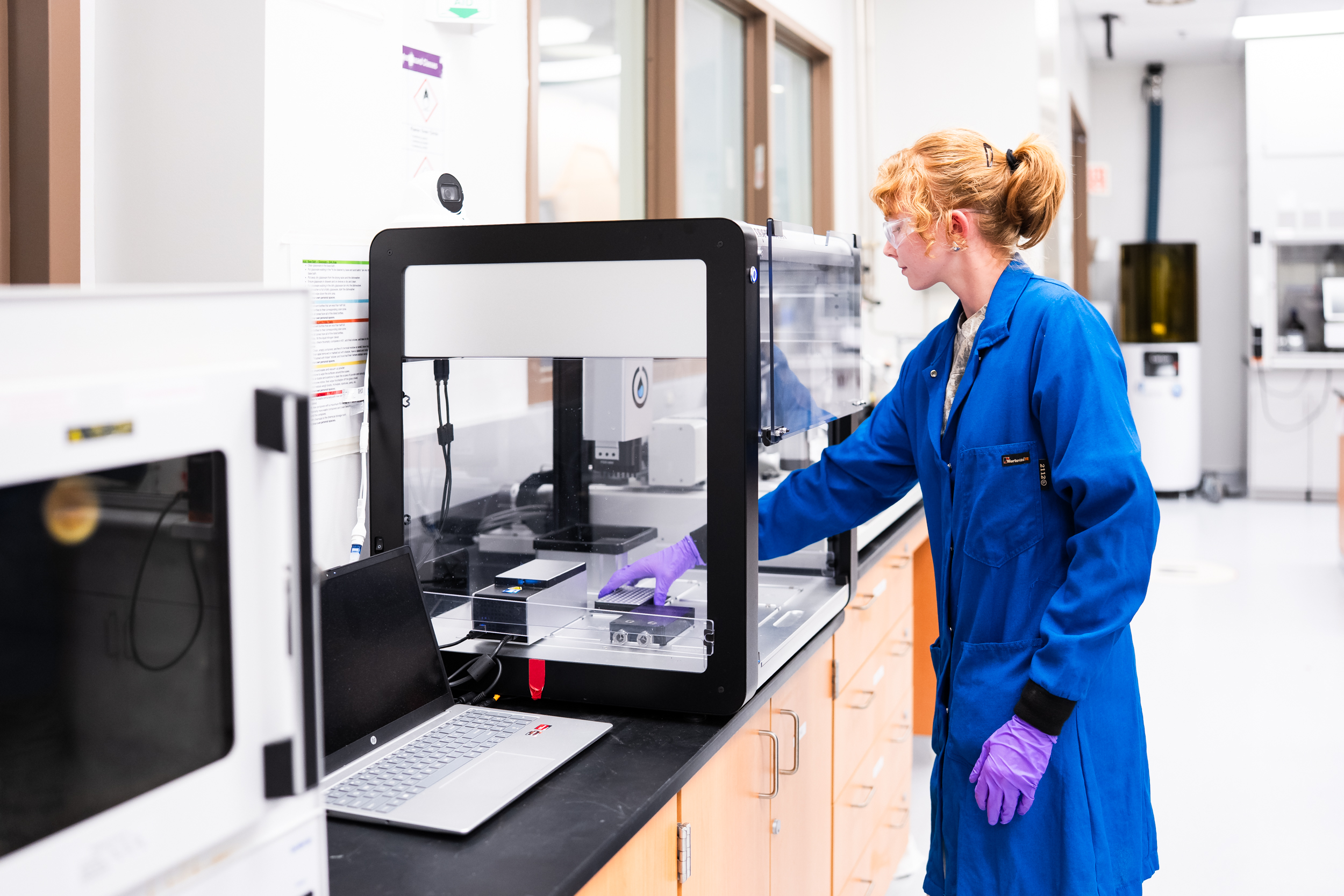
Pictured above: BioPACIFIC MIP lab assistant Marissa Beyer loads an automated robotic liquid handler inside the laboratory. COAST PCL will be built around the BioPACIFIC MIP infrastructure at OASIS. Courtesy photo.
Led by chemistry and biochemistry professor Javier Read de Alaniz, the $20 million NSF-funded facility will combine robotics, artificial intelligence and automated experimentation to accelerate the discovery of polymers and soft materials.
UC Santa Barbara has been selected to lead a new national programmable cloud laboratory that will combine robotics, artificial intelligence and advanced scientific instruments to accelerate the discovery of polymers and soft materials.
The National Science Foundation will provide $20 million over four years to establish the Computation-Optimized Automated Soft materials Technology Programmable Cloud Laboratory, or COAST PCL. One of 20 remotely accessible research nodes in a new national network, the facility will allow researchers to design experiments from their home institutions, have automated systems carry them out and use AI to help determine what should be tested next.
Javier Read de Alaniz, a professor in UC Santa Barbara's Department of Chemistry and Biochemistry, will serve as principal investigator and co-director. Materials professor Christopher Bates will also serve as co-director.
COAST PCL will be built around BioPACIFIC MIP research infrastructure at OASIS. The NSF-funded materials innovation platform, led by UC Santa Barbara and UCLA, operates as a national user facility for scientists developing bio-derived and bio-inspired materials.
The cloud laboratory will connect instruments, robotics, software, data systems and AI. By preserving information from successful, unsuccessful and routine experiments, it will create standardized data that researchers and AI systems can use to identify patterns, avoid dead ends and improve future experiments.
“Automation alone isn’t enough,” Read de Alaniz said. “You need AI that can plan experiments, interpret results and identify what to try next.”
Remote access is intended to extend sophisticated research capabilities to scientists at universities, national laboratories and companies across the country, including researchers whose institutions do not have comparable equipment or technical infrastructure.