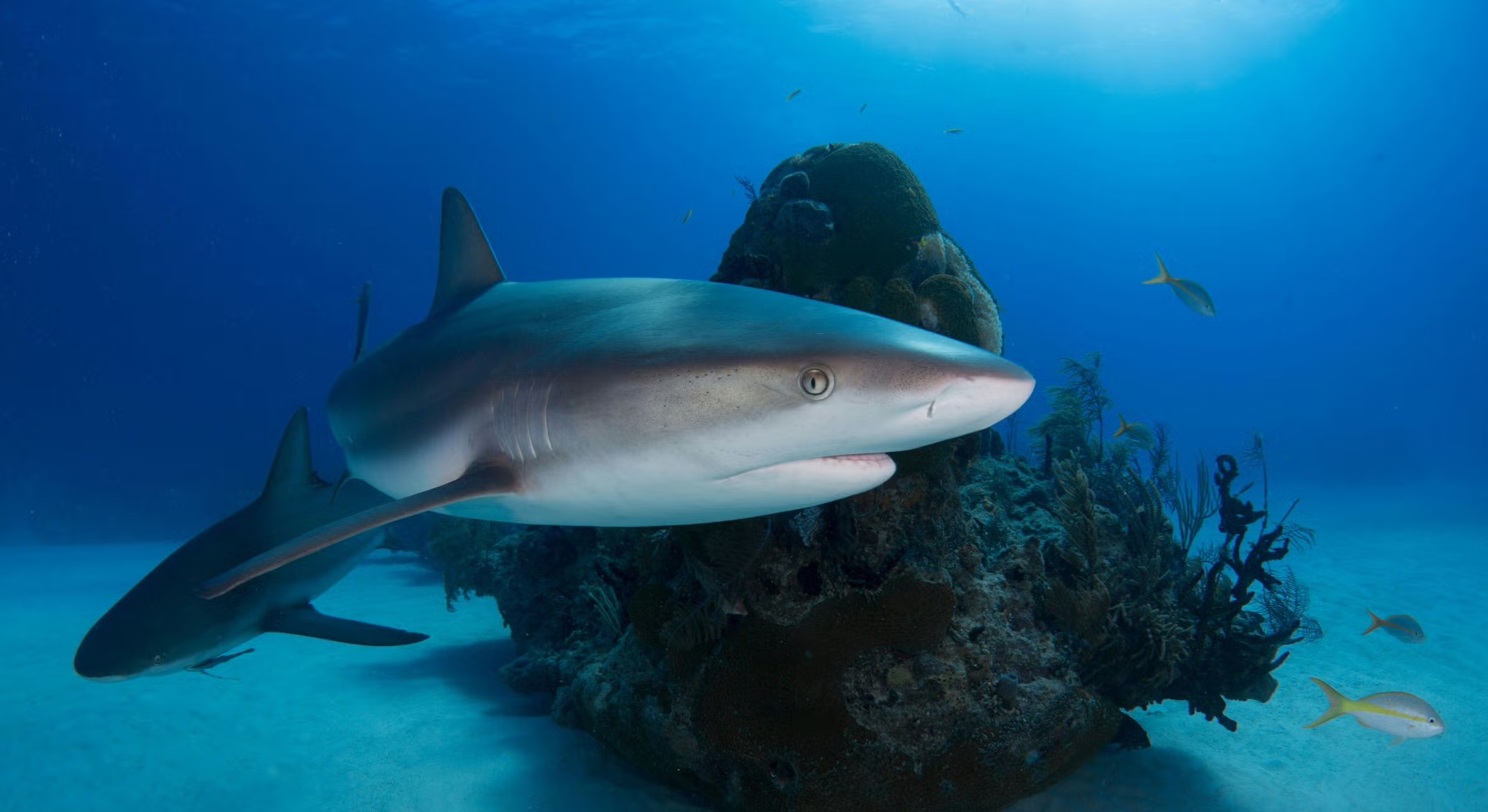
Pictured above: Caribbean reef sharks are frequent inhabitants of coral reefs, and the tiny scales they shed can persist in reef sediments for millions of years. Photo by Alex Rose on Unsplash.
Research begun at UC Santa Barbara shows why neighboring coastlines may need very different baselines for shark conservation.
Fossilized shark scales recovered from reef sediments have revealed that prehistoric shark populations on Panama’s Pacific coast were dramatically larger than those on the country’s Caribbean coast, even before intensive human fishing began.
The study, featured on the cover of Science, was led by Erin Dillon (Ph.D. ’22), who began the research during her doctoral studies at UC Santa Barbara. Co-author Douglas McCauley is a professor in the Department of Ecology, Evolution and Marine Biology.
Sharks continually shed tiny tooth-like scales called dermal denticles. Because the scales can remain preserved in reef sediments for millions of years, researchers can use them to reconstruct past shark communities.
“The shark denticle approach operates a little bit like a time machine,” McCauley said.
The researchers analyzed 3,497 denticles from 157 sediment samples on both sides of the Isthmus of Panama. Before intensive fishing, reefs in the Gulf of Panama on the Pacific coast supported roughly 20 times more sharks than comparable Caribbean reefs, despite the two regions being separated by only about 100 kilometers and sharing many of the same shark species.
The two coastlines have diverged further over time. Caribbean denticle accumulation has declined by about 75%, while Pacific accumulation rates in the study were statistically unchanged from their prehistoric baseline. Today, Pacific reefs in the study yield roughly 100 times more denticles than Caribbean reefs.
The findings show why conservation targets cannot necessarily be transferred from one neighboring ecosystem to another. Ocean productivity, environmental history and fishing pressure all help determine how many sharks a reef can support.